

AI Model Harnesses Physics to Autocorrect Remote Sensing Data
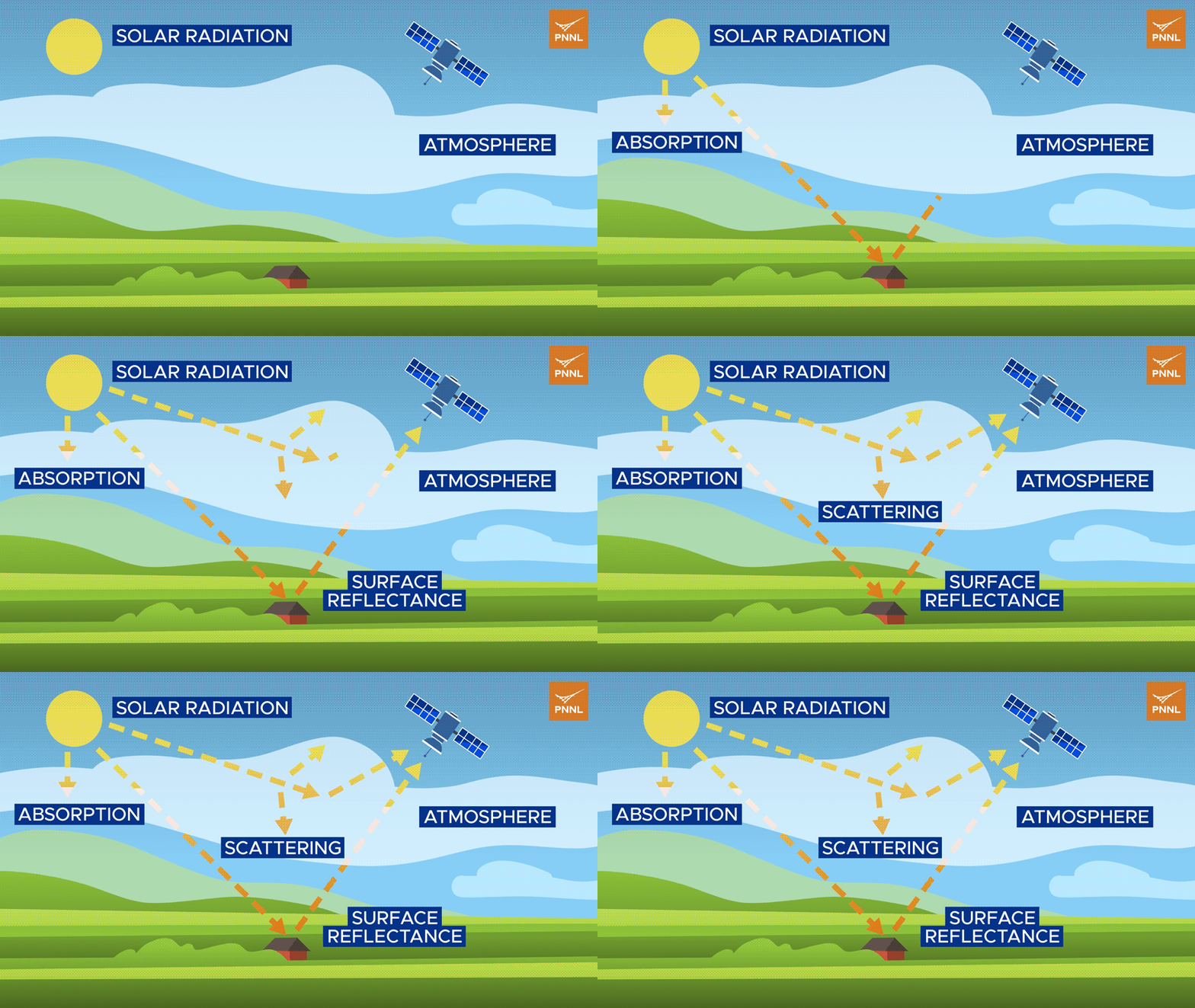
Via physics-informed machine learning, we can get good accuracy with limited data while not relying on much prior knowledge, such as where the sensor or the sun was. A James Koch (PNNL data scientist) paper at the International Geoscience and Remote Sensing Symposium in Athens, Greece.
Turbulence, temperature changes, water vapor, carbon dioxide, ozone, methane, and other gases absorb, reflect, and scatter sunlight as it passes through the atmosphere, bounces off the Earth’s surface, and is collected by a sensor on a remote sensing satellite. As a result, the spectral data received at the sensor is distorted.
Scientists know this and have devised several ways to account for the atmosphere’s corrupting influence on remote sensing data.
“This problem is as old as overhead imagery,” said James Koch, a data scientist at Pacific Northwest National Laboratory (PNNL) who developed a new way to address the problem that uses a branch of artificial intelligence called physics-informed machine learning and along the way enhances remote sensing capabilities.
Koch will present a paper describing his physics-informed machine learning framework at the International Geoscience and Remote Sensing Symposium in Athens, Greece, July 7–12. This work is part of PNNL’s remote exploitation capability and was supported by the National Security Directorate’s Laboratory Directed Research and Development portfolio.
Scientists can solve the atmospheric corruption problem because they understand the physics of how the atmosphere distorts sunlight as it passes through the atmosphere. This allows them to remove the atmosphere’s influence from the data collected at the sensor. The process is called atmospheric correction. An atmospheric transmission profile is generally required prior knowledge to perform atmospheric correction. The profile is a representation of the properties and composition of the atmosphere at different altitudes that shows how light at different wavelengths interacts with an atmosphere.
The process of creating an atmospheric transmission profile without prior knowledge is where Koch’s AI technique is a potential game changer.
Today, many atmospheric correction applications rely on off-the-shelf tools that use generic, statistics-based atmospheric profiles. These tools are sufficient for time-sensitive tasks such as disaster response monitoring and are cost efficient when mapping a large area. Applications where high accuracy is paramount, such as target detection, require the data-intensive and computationally expensive creation of high-fidelity profiles.


Comments